
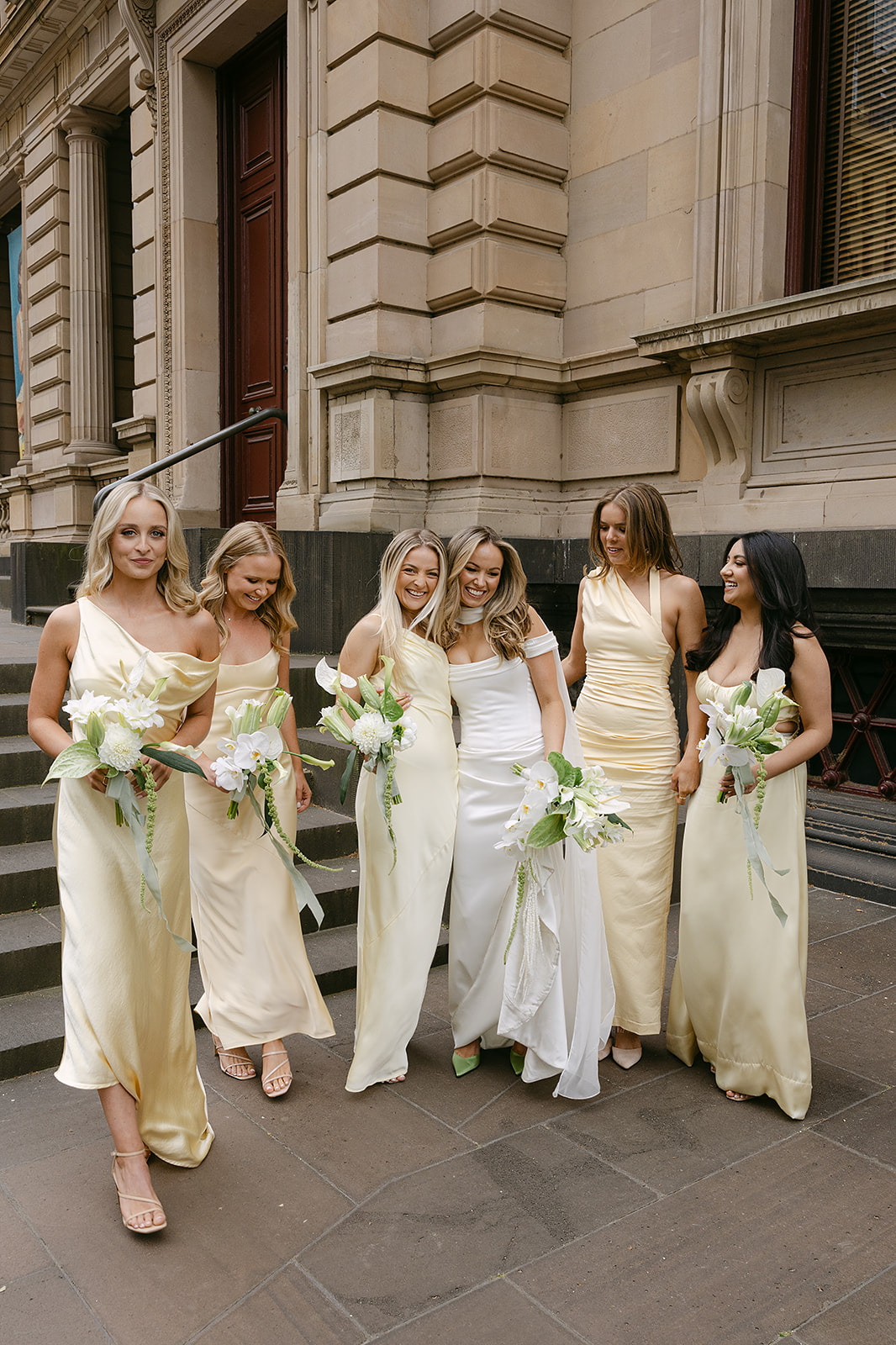
For the couple who wants the ceremony to belong entirely to them, and then wants to celebrate without reservation with everyone they love.
Lucinda and Jesse did not want a traditional wedding.
They wanted two things, held separately and in the right order: the marriage itself, intimate and entirely theirs, in one of the most architecturally extraordinary buildings in Melbourne. And then a party. A real one, with their friends, with no ceremony logistics to manage, no seating charts pulling focus, no timeline pressure sitting over the evening.
What they did instead was this. They married at the Treasury Building on Spring Street, witnessed by the people closest to them, in a ceremony that belonged to no one but them. Then that evening, in the middle of a celebration their friends believed was simply a party, they played the reveal video.
The room found out they were married in real time.
That moment, the collective recognition, the disbelief breaking into joy, the particular quality of celebration that only happens when something genuinely surprises people who love you, is one of the most extraordinary things I have photographed. It cannot be staged. It cannot be rehearsed. It happened because Lucinda and Jesse designed their day around what actually mattered to them rather than around convention.
Why the two-part wedding format is the most considered way to get married
The traditional wedding format asks a couple to hold two quite different emotional registers on the same day in front of the same audience.
The ceremony: intimate, significant, the most privately meaningful exchange two people can make. The reception: celebratory, social, genuinely a party. These are not the same emotional experience and they do not always sit comfortably alongside each other. The solemnity of exchanged vows and the energy of a room that wants to celebrate can pull in opposite directions, and managing both in a single continuous day asks something significant of the couple at the centre of it.
Separating them, as Lucinda and Jesse did, resolves that tension entirely. The ceremony is protected. It belongs only to the couple and the very few people they chose to witness it. Nothing about it needs to be managed for an audience of a hundred people. The exchanges are private. The emotion is unobserved. The photographs from that room reflect two people who are entirely present with each other because there is no performance required.
The party that follows is freed from the weight of the ceremony. The guests arrive to celebrate rather than to witness. The energy of the room is singular rather than divided. And when the reveal happens, the guests experience the marriage as news rather than as something they watched unfold, which produces a quality of joy and surprise that a conventional reception simply cannot generate.
The Treasury Building: why it matters
The Treasury Building on Spring Street was completed in 1857, designed by nineteen-year-old John James Clark in the Italian Renaissance Revival style, built from Pyrenean granite and Barrabool Hills sandstone. It held Victoria’s colonial gold reserves in basement vaults that are still intact beneath the building. For decades it was the financial and administrative nerve centre of the colony, and the weight of that history is present in every room.
It is now managed by the City of Melbourne and available for events and ceremonies through the Old Treasury Building. The bluestone and sandstone facade, the extraordinary rendered ceilings, the period cornicing and joinery, the scale of the rooms: all of it is original and all of it is National Trust listed.
For a registry ceremony, it provides something no contemporary venue can replicate: genuine civic gravitas. The sense that this marriage is being witnessed not just by the people in the room but by a building that has held the weight of significant moments for nearly 170 years. That context does not need to be articulated on the day. It is felt.
Photographically, the Treasury Building is one of the most rewarding interiors in Melbourne. The light that comes through the original windows. The ceiling details and the scale of the rooms. The contrast between the formal grandeur of the architecture and the intimacy of a small private ceremony within it. The exterior bluestone facade on Spring Street for portraits against one of Melbourne’s most recognisable and historically significant streetscapes.
What registry ceremony photography actually requires
A registry or civil ceremony at the Treasury Building is intimate by nature. A small number of witnesses, a celebrant, the couple. The photographer is not working within a large room with space to move freely. They are working close, quietly, in a space where every person present is visible in every frame.
This requires a specific approach. The camera needs to be unobtrusive, not just in behaviour but in presence. The kind of photography that works in a small, private ceremony is not the same as the kind that works in a garden with fifty guests and a wide aisle to work from. It requires the ability to be genuinely invisible, to anticipate moments rather than react to them, to work with available light rather than introduce anything that changes the atmosphere of the room.
What it produces, when done well, is a set of images that feel like private documents rather than public records. The specific quality of light in the Treasury Building’s rooms. The scale of the architecture around two people doing the most significant thing they will do together. The faces of the witnesses rather than the faces of a crowd.
These are not the photographs that will end up on Instagram. They are the photographs that will be in the album that sits on the shelf for the rest of a life, taken out occasionally and held with a kind of quiet recognition that the bigger, louder, more widely shared images rarely produce.
The reveal: what it does to a room
I want to be specific about what happens when a ceremony reveal works, because it is worth understanding before committing to the format.
The guests at Lucinda and Jesse’s party arrived believing they were celebrating with a couple they loved. The music, the drinks, the atmosphere of the evening, all of it was already good. And then the video played.
The recognition moved through the room in stages. The first people who understood what they were seeing. The realisation spreading outward. And then the particular sound that a room makes when genuine collective joy arrives unannounced: louder, more disorganised, more purely felt than any planned moment of a conventional reception.
That sound cannot be engineered. It is the product of real surprise meeting real love, and it only happens once. The photographs from those moments, the faces in the room during the reveal, the couple watching their friends find out, the embraces and the tears and the complete abandonment of composure, are among the most true and specific images I have ever made at a wedding event.
The reveal format asks something of the couple: a willingness to keep a significant secret from the people they love, sometimes for weeks or months, for the sake of a moment that cannot be replicated any other way. The couples who make that choice tend to be certain about it. They know their people. They know how the room will respond. And they are right.
Who this format suits
The two-part wedding is not the right choice for everyone and it is not trying to be. It suits couples who are clear-eyed about what they want from the marriage itself versus what they want from the celebration. Who find the conventional format, the ceremony as public performance and the reception as managed event, slightly at odds with how they actually want to experience both.
It suits couples who value the intimacy of the ceremony enough to protect it entirely. Who want their vows to be genuinely private rather than delivered to an audience who will then immediately transition into cocktail hour mode. Who want to be married before the party begins rather than in the middle of the event.
And it suits couples who trust their friends enough to know that the reveal will land. That the people they love will respond to the surprise with the kind of unconstrained joy that makes the moment worth holding in reserve for.
Lucinda and Jesse were those people. The Treasury Building held the ceremony with exactly the gravity it deserved. The party held the celebration with exactly the freedom it needed. And the photographs from both parts of the day tell a complete story that neither could have told alone.
Frequently Asked Questions About Registry and Two-Part Wedding Photography in Melbourne
What is a registry or civil ceremony wedding in Melbourne? A registry or civil ceremony is a legally recognised marriage ceremony conducted by a licensed celebrant, typically in a smaller, more intimate setting than a traditional church or venue wedding. In Melbourne, couples can choose locations like the Old Treasury Building, private residences, restaurants, gardens, or any location that suits the couple and their celebrant. The ceremony is legally binding and does not require a large guest list or a reception to follow.
What is the Old Treasury Building in Melbourne and can you get married there? The Old Treasury Building on Spring Street is a National Trust listed 1857 Italian Renaissance Revival building designed by John James Clark, one of Melbourne’s most significant historic structures. It is managed by the City of Melbourne and is available for private events, ceremonies, and functions. Couples can hold intimate civil ceremonies in the historic rooms of the building. For bookings and availability, contact the Old Treasury Building directly.
What is a ceremony reveal wedding and how does it work? A ceremony reveal is a format where a couple holds their marriage ceremony privately with a small number of witnesses, and then later plays a video or announces the marriage to their wider guest list at a separate celebration. The guests experience the wedding as a surprise rather than as a witnessed event. The reveal format produces a specific quality of joy and genuine surprise in the room that a conventional reception cannot generate.
How do you photograph an intimate registry ceremony differently from a traditional wedding? Registry ceremony photography requires a quieter, more unobtrusive approach than traditional wedding photography. The smaller space, the intimate guest count, and the private nature of the ceremony all call for available light work, close proximity without visible presence, and the ability to anticipate moments in a confined environment. The images produced tend to feel like private documents rather than public records, which is usually exactly what couples choosing this format are looking for.
Can you photograph both the ceremony and the reveal party as separate events? Yes. Photographing both parts of a two-part wedding day gives the complete story: the intimacy of the ceremony and the specific quality of joy that only a reveal produces. The two sets of images are distinct in atmosphere and in the emotions they capture, and together they document a way of getting married that is becoming increasingly considered by couples who want both a private marriage and a genuine celebration.
Do you photograph intimate and registry weddings in Melbourne? Yes. Intimate ceremonies, registry weddings, two-part wedding days, and non-traditional wedding formats are some of the most rewarding work I do. If you are planning something that does not fit the conventional mould and you want photography that understands and matches that, I would love to hear from you.
If you are planning an intimate ceremony, a registry wedding, or a two-part wedding day in Melbourne and want photography that treats both parts with equal intention, I would love to hear about it.


