
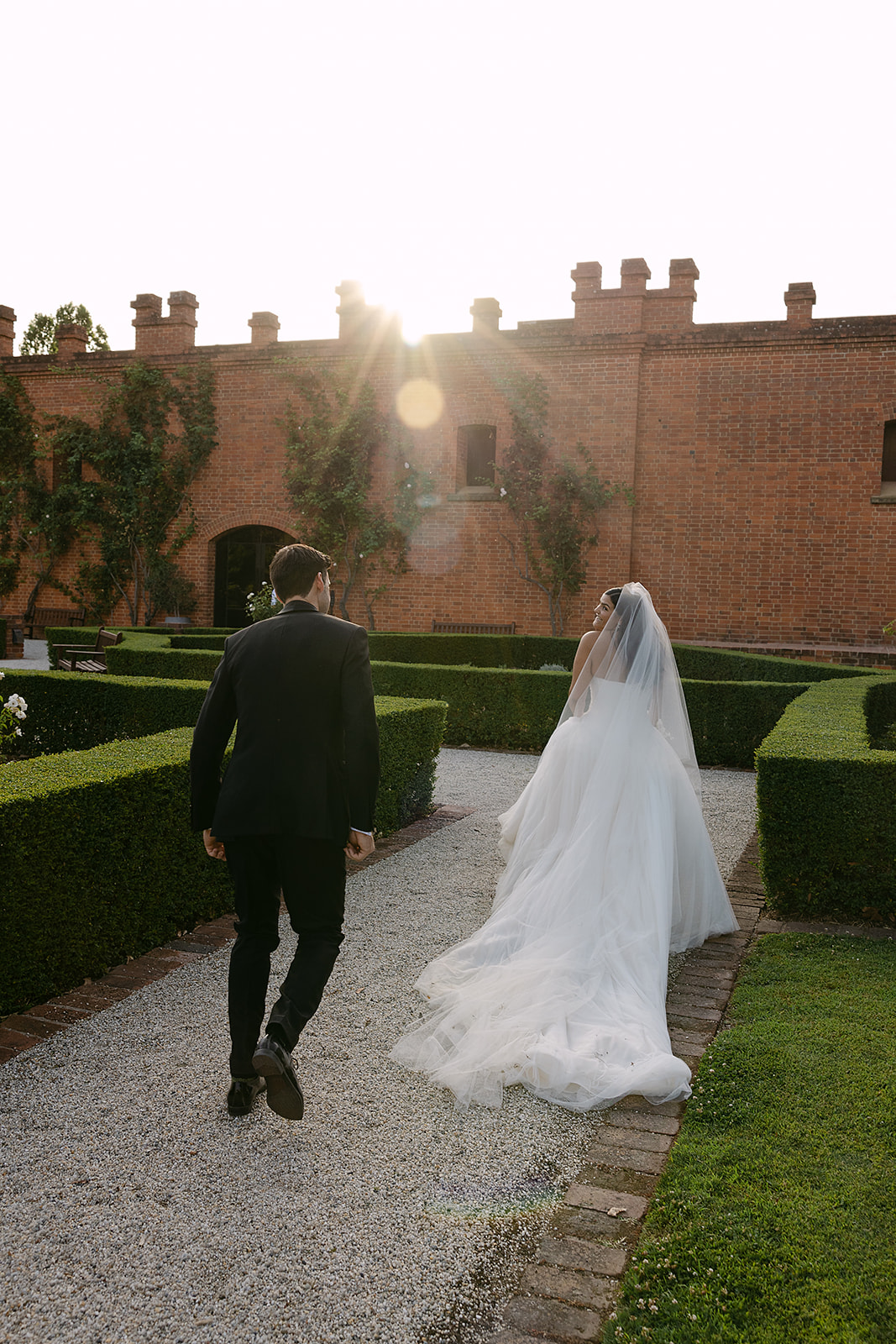
This post is for the couple who has done the research, knows what they want, and is now trying to work out which photographer will actually deliver it.
There is a particular kind of wedding that All Saints Estate attracts.
Couples who chose Rutherglen deliberately. Who wanted the castle, the 150-year-old elm driveway, the Great Hall with O’Sullivan foudres lining the walls and fortified wines maturing inside them. Couples who are hosting, properly hosting, and who understand that the venue, the food, the wine, the atmosphere, and the photography all need to operate at the same standard.
Built in 1864 by two Scottish engineers who arrived from Caithness and constructed the castle largely by hand, All Saints is heritage-listed, family-owned, and still making wine the same way. It is not a converted function centre. It has history running through the brickwork. And couples who choose it tend to feel that distinction acutely. They do not want generic photography layered on top of something this specific.
So. How do you know if a photographer is actually right for a day like this?
The question most couples ask and the better one they should be asking
Most couples approach photographer research by asking: do I like their photos?
That is a reasonable starting point. But it is the wrong finishing point.
A more useful question is: does this photographer understand how to lead a day like mine, and will I barely notice they’re there?
At a venue with the scale and character of All Saints, the photography challenge is not finding beautiful backdrops. The elm driveway alone is one of the most dramatic arrival sequences I have ever photographed. The Rose Garden with its water lily pond and layered greenery. The Cask Hall with its original brick fired on the property, barrels of maturing muscat stacked behind every frame. The tower with 360-degree views over vineyard and river. The architecture does not need you to work hard. It needs you to know what to do with it.
The real question is whether your photographer can read all of that, quickly, calmly, without disrupting the pace of your day, and translate it into a gallery that feels as considered as the celebration itself.
Five things to look for when assessing a photographer for a destination estate wedding
1. They have a clear, consistent point of view
A photographer’s portfolio should not look like a greatest hits of different styles. Moody one week, bright and airy the next, film-grain the week after. Inconsistency in a portfolio signals that the photographer is chasing trends or client preferences rather than working from a genuine visual language.
What you want is a body of work that looks like it was made by the same person, with the same eye, across different venues, different seasons, different light conditions. At a venue like All Saints, where you have the warm stone of the Cask Hall, the green tunnelled light of the elm driveway, the open evening sky over the Murray River plains, your photographer needs a visual language that holds across all of it.
Ask yourself: if I removed the venue from these images, could I still tell who took them?
If the answer is yes, that is a photographer with a point of view.
2. They protect your time without being asked
This is the one most couples do not think to assess until after the wedding, when they either reflect on how effortlessly the day moved or quietly wish they had been back at the table sooner.
A photographer who understands a hosting-first wedding will already have a position on portrait timing before you raise it. They will tell you, unprompted, how they approach efficient couple portraits. They will not pitch you on a two-hour golden hour session as a selling point. They will tell you that twenty well-led minutes will give you more than two hours of wandering.
All Saints is a venue where your guests are having an extraordinary experience. Award-winning wine, hatted restaurant food under Executive Chef Jack Cassidy, a Great Hall that seats up to 160 in a space that genuinely cannot be replicated anywhere else. The right photographer understands their job is to document that experience, not to pull you away from it.
If you ask a photographer how long portraits take and they hedge, give you a range without conviction, or seem primarily focused on light conditions over your guest experience, note that.
3. They can describe how they handle specific conditions at the venue
Any photographer can say they love All Saints. A photographer who knows what they are doing can tell you specifically how they handle the dappled light of the Rose Garden ceremony, what time of day the elm driveway works best, and how they approach the low, warm, complex light inside the Great Hall without losing the atmosphere that makes the room what it is.
The elm driveway is a 300-metre arrival of stacked golden green light filtered through branches that are a century and a half old. It is genuinely extraordinary. It is also technically specific. Direction of light changes across the day, the canopy behaves differently depending on season, and the length of the drive means you are walking a long way with one chance to document it well.
When you speak to a photographer about All Saints, ask specific questions. What ceremony location do they prefer and why? What is the hardest thing to photograph at this venue? How do they handle the interior reception once the evening light has gone? The quality of the answer tells you more than the portfolio.
4. They communicate with calm confidence, not performance
The way a photographer communicates before the wedding is a direct preview of how they will behave on the day.
A photographer who is performatively enthusiastic in every reply, who uses a lot of wedding industry superlatives, who seems to be auditioning for the role, that energy translates to the wedding day. It translates to a day that feels photographed rather than hosted.
What you want is someone who is warm but efficient. Who answers your questions directly. Who does not over-explain their value because they do not need to. Who gives you the sense that they have done this many times and that your day is in experienced hands.
The communication style is the audition. Trust it.
5. Their previous clients sound like you
Testimonials are useful, but read them for specificity, not sentiment. Generic praise like she was amazing, the photos are beautiful tells you very little. What you want are testimonials that describe the experience of the day itself: how the portrait timing felt, how the couple was led, how guests responded, how the gallery reflected the standard of the celebration.
If a photographer’s clients consistently talk about ease, calm, efficiency, and a gallery that exceeded their expectations, that is a pattern. If testimonials are warm but vague, or if there are very few of them, keep looking.
What All Saints specifically needs from a photographer
I want to be direct about this because I think it helps.
All Saints is not a venue for photographers who need a long run-up. The elm driveway arrival happens once. The ceremony light in the Rose Garden shifts quickly. The way the Cask Hall looks in the last twenty minutes before dinner service is something you either catch or you do not.
This is a venue that rewards experience. Not just technical experience, but the kind of settled confidence that comes from photographing 800+ weddings across different formats, different light conditions, different levels of complexity. The kind where you already know what the next twenty minutes will look like before they happen, so you are already positioned.
The Great Hall at All Saints has barrels lining the walls containing maturing port, muscat and Muscadelle, the same bricks fired on the property, the same foudres cooperated in the early 1900s. That is the context your gallery sits inside. It deserves a photographer who matches it.
A note on destination weddings from Melbourne
All Saints is approximately three and a half hours from Melbourne. It sits on the Murray River near Wahgunyah in North East Victoria, a genuine destination requiring overnight accommodation for most guests.
Couples who choose destination venues at this distance do so because proximity was never the point. They wanted this specific experience, at this specific estate, and they have planned accordingly. Their photographer should approach it the same way.
I photograph destination estate weddings across Victoria and internationally, and what I find is that the best destination wedding days share a pace that city weddings rarely have. Slower. More present. Guests who have committed to the journey and are fully there. That quality is one of the gifts of an All Saints wedding, and a photographer who understands it will document it rather than rush through it.
Frequently Asked Questions About Wedding Photography at All Saints Estate Rutherglen
Is All Saints Estate in Rutherglen good for wedding photography? Yes, genuinely exceptional. The combination of the heritage castle, 150-year-old elm driveway, the Rose Garden, the Cask Hall interior, and the open vineyard landscape gives a photographer significant variety across the day. It is one of the most photographically rich estate venues in Victoria, provided you work with a photographer experienced enough to use it well.
How far is All Saints Estate from Melbourne for a destination wedding? All Saints Estate is located in Wahgunyah, approximately three and a half hours from Melbourne via the Hume Highway. Most couples plan it as a multi-day celebration given the travel involved, which creates the kind of unhurried pace that produces exceptional photography.
What are the best ceremony locations at All Saints Estate? The Elm Driveway and the Rose Garden are the two most-used ceremony spaces. The Elm Driveway is one of the most dramatic ceremony settings in Victoria, a 300-metre arrival lined with 150-year-old trees that create a tunnelled canopy of light. The Rose Garden offers a softer, more intimate setting with the water lily pond and layered hedged gardens. Both photograph beautifully; the choice depends on the scale and atmosphere you want.
How long does photography take at an All Saints Estate wedding? For a well-paced All Saints wedding, I recommend 20 to 30 minutes of dedicated couple portraits and an approach that is otherwise documentary throughout the day. The venue itself, the driveway arrival, the ceremony setting, the Cask Hall, the vineyard light, provides abundant context without needing to manufacture content. You should spend your day hosting, not posing.
Do you travel to Rutherglen for weddings? Yes. I photograph destination estate weddings throughout Victoria and internationally. All Saints Estate is a venue I know well and return to with genuine enthusiasm. If you are planning a celebration there, I would love to hear about it.
What style of photography suits All Saints Estate? The estate’s heritage architecture, the weight of its 160-year history, and the depth of the venue’s character suit an editorial-documentary approach. Imagery that is visually considered but emotionally honest. Heavily posed, trend-driven photography tends to sit awkwardly against All Saints’ authenticity. The strongest galleries from this venue let the estate speak and capture the couple within it.
If you are planning a wedding at All Saints Estate in Rutherglen and you want photography that matches the standard of the day you are creating, I would love to hear from you.
You can enquire here, or browse recent work from Victoria’s estate and winery venues here.


