
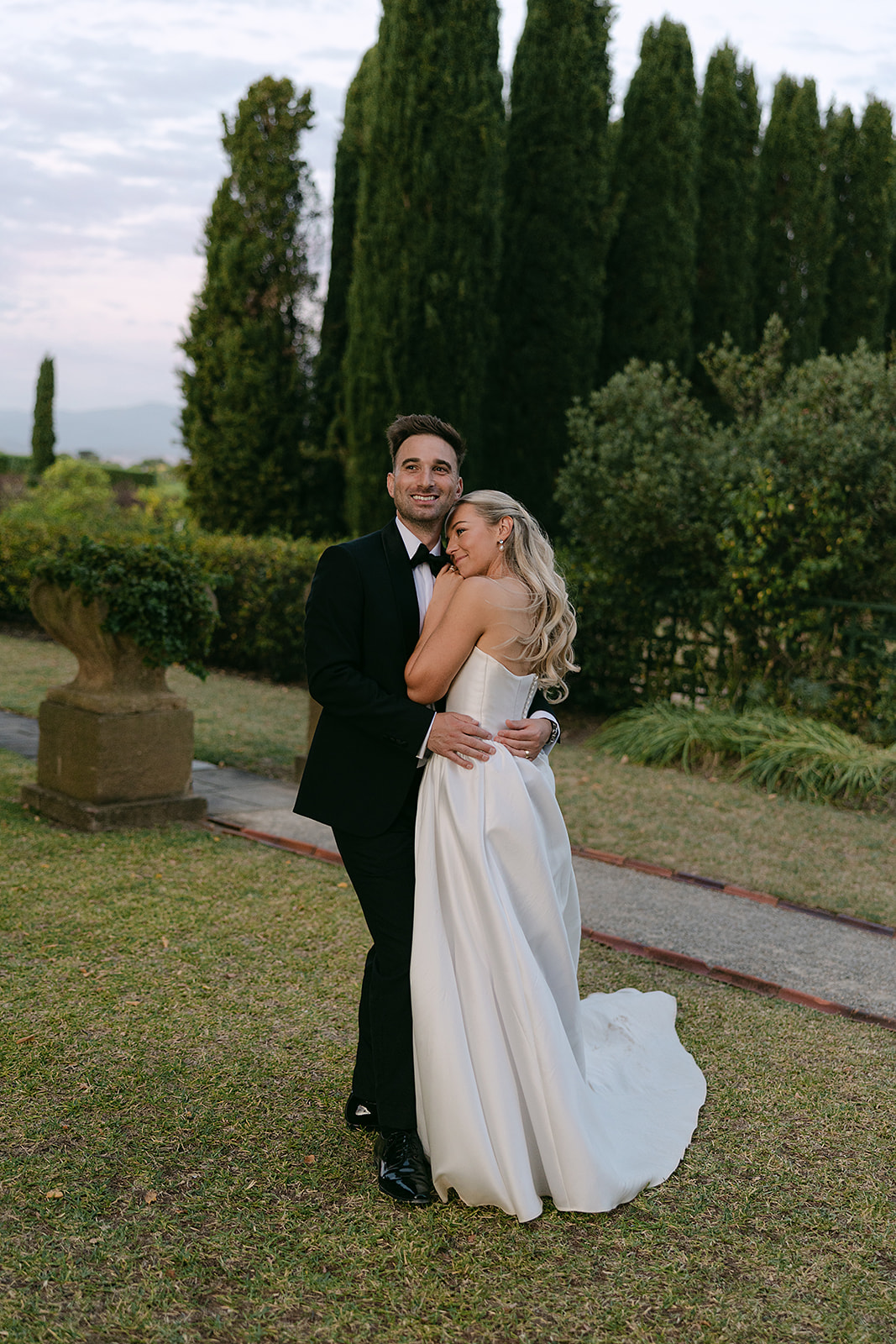
This post is for the couple who cares deeply about their guests. Who designed the day around the people in the room, not around the photographs. Who wants a gallery that reflects that.
There is an image from Tara and Phil’s wedding at Coombe Yarra Valley that I keep coming back to.
It is not a portrait. It is not a golden hour shot in the Italian Garden. It is Tara’s nana, fully present, completely unselfconscious, celebrating in the middle of the room with the kind of joy that you cannot direct, cannot recreate, and absolutely cannot manufacture by asking someone to look at the camera and smile.
That image exists because nobody in the room was thinking about the photography. They were thinking about Tara and Phil.
That is the environment that produces the best wedding galleries. Not a perfectly managed portrait sequence. A room full of people who have forgotten the photographer is there.
The assumption most couples make about wedding photography
The majority of wedding photography conversations start in the same place. How many hours. Which locations for portraits. Whether there is time for golden hour. How to get the family groups done efficiently.
All of that is worth discussing. But it is the wrong starting point.
The starting point should be: what kind of day are we creating, and what does the photography need to do inside that day?
If the day is built around hosting — around the experience of the guests, the quality of the table, the warmth of the room, the feeling that everyone present is genuinely celebrated — then the photography needs to operate in service of that. It needs to be present without being intrusive. It needs to find the story in the room rather than pulling the couple out of it to manufacture one in the garden.
At a venue like Coombe, where Dame Nellie Melba’s estate has been restored into one of the most considered hospitality environments in the Yarra Valley, where the gardens and the reception space are designed to create a specific atmosphere, the room is already doing the work. A photographer who understands that works within it. One who does not will spend the day trying to recreate something the venue has already given you for free.
What Tara and Phil’s day actually looked like
Tara and Phil did not design their Coombe wedding around the photographs. They designed it around the people.
The result was a day with a quality that is genuinely difficult to achieve and impossible to fake: full presence. Guests who were not performing for documentation but living inside the celebration. Tara’s nana was front and centre from the ceremony through to the reception, celebrating without restraint, without self-consciousness, without any awareness that there was a lens nearby capturing her. She was simply there, entirely, for her grandchild’s wedding day.
Those are the frames that last. Not because they are technically extraordinary, though they can be. Because they are true in a way that posed portraits rarely are. Because in twenty years when Tara looks at her wedding gallery, the image of her nana in that room will carry a weight that no portrait session could have produced.
The guests at Tara and Phil’s wedding moved through the day the same way. Present, celebratory, unconscious of the camera. When people are not performing for photographs they inhabit the space differently. They lean in closer, laugh more openly, hold each other longer. The room has a quality that every guest feels and that a documentary-focused photographer finds everywhere they point the lens.
Why documentary coverage requires more skill, not less
There is a misconception worth addressing directly.
Some couples assume that documentary wedding photography is the easier approach. That it simply means following people around and pressing the shutter. That a more directed, portrait-heavy approach requires more expertise.
The opposite is true.
Posing produces predictable results. You place people in positions that work, you use the light you have arranged or chosen, and you produce an image that looks like what you intended. The skill ceiling is real but the floor is reasonably high. A competent photographer with a good location and willing subjects will produce something presentable.
Documentary coverage at a high level is harder because the photographer cannot control the inputs. They cannot ask the moment to wait, cannot arrange the light, cannot position the subjects. They can only be in the right place before the moment happens, with the right settings already dialled, and the compositional instinct to frame something truthful inside whatever is unfolding.
This requires knowing a room. Reading how a group of people is moving and where the energy is going before it arrives. Understanding light not as something to seek out and use but as something to navigate continuously across an environment you did not set up and cannot change. Anticipating rather than reacting.
At Coombe, with the reception space’s floor-to-ceiling windows and the way the afternoon light moves through the Italian Garden and across the gardens as the day progresses, this is a specific skill. The light does not hold still. The room does not wait. The moments that matter most, a grandmother’s face at the exact instant her grandchild says their vows, a group of old friends finding each other during cocktail hour, the look between two people who do not know you are watching, happen once and they happen fast.
What a hosting-first wedding actually needs from a photographer
Tara and Phil wanted their guests to feel celebrated and their day to feel effortless. Not a production. Not a series of scheduled photography moments with the celebration woven around them. A genuine wedding day with a photographer working quietly in the margins of it.
This requires a specific kind of trust and a specific kind of brief. It means being clear with your photographer, before the day, about what the priorities are. That you want the room documented, not just the couple. That you value the image of your nana laughing with your mother at the table over a technically perfect portrait of the two of you against the Italian Garden hedge. That you are hiring them to find the story, not to direct it.
A photographer who is oriented around portrait production will hear that brief and feel professionally underused. A photographer who understands that documentary coverage at this level is more demanding, not less, will hear it and understand exactly what is being asked of them.
The galleries that come from days like Tara and Phil’s are not full of the expected images. They are full of the true ones. And at a venue like Coombe, where the experience of the day is already extraordinary and the guests already know it, the true images are everywhere. You simply need a photographer who knows how to find them.
What Coombe specifically offers a documentary approach
The Italian Garden and the Oak Tree ceremony locations both create a natural focus for guests during the ceremony itself. People are oriented, present, and emotionally open in a way that the preceding hour rarely produces. The first frames of genuine documentary gold at most Coombe weddings come from the ceremony, when the couple’s faces are doing things neither of them would choose to perform, and the guests in the surrounding rows are responding to it in real time.
The reception space at Coombe, with its floor-to-ceiling windows overlooking the gardens and its configuration that keeps the room intimate even at larger guest counts, is designed for the kind of atmosphere where people settle in and celebrate properly. The long table format that many couples choose here keeps everyone connected across the meal. The room does not fragment the way a round-table configuration can. The energy stays contained and the photographer can move through it continuously rather than chasing scattered pockets of conversation across a large floor.
The grounds between ceremony and reception, the gardens, the pathways, the areas around the cellar door, are where cocktail hour happens and where the documentary work is often at its most relaxed and its most revealing. Guests with a glass in hand and the formality of the ceremony behind them tend to be at their most genuinely themselves. This is where the images of people that will matter most in twenty years are often made.
Frequently Asked Questions About Documentary Wedding Photography at Coombe Yarra Valley
What is documentary wedding photography and is it right for a Coombe wedding? Documentary wedding photography prioritises capturing the day as it unfolds rather than directing couples and guests into posed or constructed moments. At a venue like Coombe, where the grounds, the gardens, and the reception space create a naturally rich environment and where couples tend to be hosting-focused rather than photography-focused, a documentary approach produces galleries that feel emotionally true and specific to the day rather than interchangeable with any other wedding at any other venue.
How many portraits do you need for a Coombe wedding gallery? Fewer than most photographers will tell you. A well-directed twenty minutes in the right location at the right time of day will give you everything you need from couple portraits. The majority of the images in a strong Coombe gallery come from the ceremony, cocktail hour, the reception room, and the moments between, not from a extended portrait session. If your priority is hosting and celebrating with your guests, your portrait time can reflect that without compromising the quality of the overall gallery.
What makes guest photography important at a wedding? Your guests are the context in which your love story exists. The images of the people who love you most, responding to the day you created, are often the ones that carry the most weight over time. A gallery that documents only the couple misses most of what made the day what it was. The moments between guests, the reactions during speeches, a grandparent at the table, a group of old friends reconnecting during cocktail hour, these are the frames that a documentary approach prioritises and that a portrait-focused approach can overlook.
What does hosting-first wedding photography actually mean? It means your photographer is oriented around your guest experience rather than their own portrait requirements. Practically, it means efficient portrait timing that returns you to your guests quickly, a documentary approach to the room and the people in it throughout the day, and a gallery that reflects the atmosphere of the celebration you created rather than a series of constructed images made away from it. The best hosting-first galleries feel like the day actually felt, not like an edited version of it.
Can you have both strong portraits and strong documentary coverage at Coombe? Yes, and this is the approach I take. A focused, well-directed portrait session of twenty to thirty minutes produces strong couple imagery without pulling you away from your guests for an extended period. The rest of the day is worked documentarily, with the same visual standard applied to the room, the guests, and the unfolding story of the celebration. The strongest Coombe galleries I have produced combine both, with the portrait session as a deliberate, efficient chapter in a day that is otherwise documented rather than directed.
Do you photograph weddings at Coombe Yarra Valley regularly? Yes. Coombe is one of the venues I photograph most often and I am based nearby in the Yarra Valley. If you are planning a Coombe wedding with a focus on hosting, guest experience, and documentary coverage, I would love to hear from you.
If you are planning a wedding at Coombe Yarra Valley and want photography that keeps you in the room with your people rather than pulling you away from it, I would love to hear about your day.
You can enquire here, or read more about how I approach Coombe photography here.


